
3D X-Ray Vienna –
Precise Diagnostics
in Three Dimensions
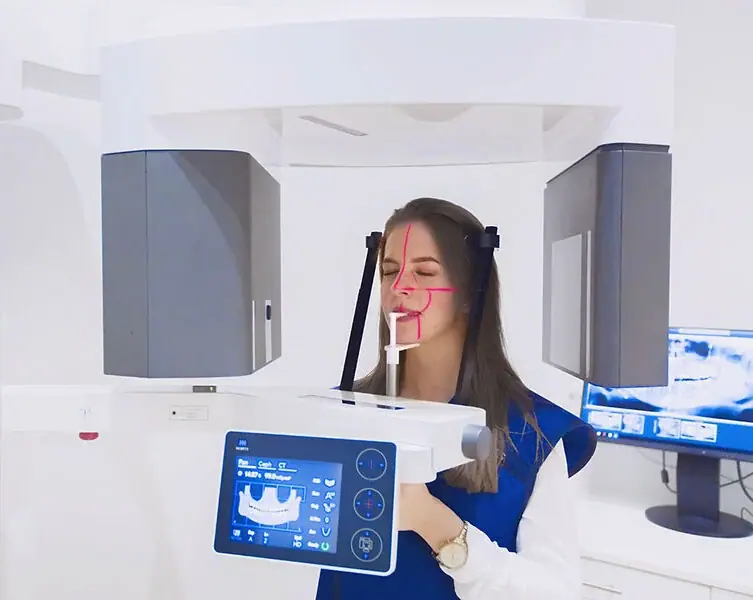
Cone Beam CT (CBCT / DVT) delivers three-dimensional images of teeth, jawbone and surrounding structures – for more accurate diagnosis and safer planning of complex treatments.
- Three-dimensional visualisation
- Optimised low-dose technique
- Precise implant planning
- Detailed root canal diagnostics
What is Cone Beam CT (CBCT)?
Cone Beam Computed Tomography – also called CBCT, DVT or 3D dental X-ray – is a specialist imaging technique for the jaw and facial region. Unlike conventional 2D X-rays, CBCT provides three-dimensional cross-sectional images allowing more precise assessment of bone structure, tooth roots, nerve pathways and anatomical features. The radiation dose is significantly lower than a medical CT scan.
What is 3D X-Ray used for?
CBCT scans are used selectively for treatments where 2D X-rays are insufficient – following the principle: as little radiation as necessary, as much information as possible.
Implant Planning
Before implant placement, precise knowledge of bone volume, bone density and the course of the inferior alveolar nerve is essential. CBCT provides all necessary information for safe and precise implant planning – including digital surgical guide fabrication.
- Accurate bone volume measurement
- Visualisation of nerve pathway
- Sinus assessment before sinus lift
- Basis for digital drill guides (guided surgery)
Endodontic Diagnostics
For complex root canal cases, CBCT shows the exact number, course and anatomy of the canals as well as fractures, periapical lesions or cysts – findings that often remain hidden on 2D X-rays.
- 3D visualisation of all root canals
- Detection of longitudinal fractures
- Assessment of periapical lesions & cysts
- Planning of retreatments
Orthodontics & Surgery
Displaced or impacted wisdom teeth, orthodontic diagnostics and surgical procedures benefit from three-dimensional visualisation. Jaw joint diagnostics and assessment of sinus changes are also possible.
- Position assessment of impacted wisdom teeth
- Skeletal jaw analysis for orthodontics
- Temporomandibular joint diagnostics (TMD)
- Assessment of sinus changes
CBCT Scan Process
Indication
CBCT is only indicated after clinical examination and assessment – when 2D X-rays are insufficient. We explain to you why the scan is necessary.
CBCT Scan
You stand or sit still for approximately 15–40 seconds in the device. The device rotates once around the head – no confined space, no tube. Quick and comfortable.
Digital Evaluation
The 3D image data is evaluated immediately on computer. We can view cross-sections in all planes and perform measurements.
Results Discussion
We discuss the findings with you – clearly and using the images. The digital data can be forwarded to specialists if required.
Cost of CBCT Scan
Costs depend on the volume of the scan (single tooth, jaw section, full jaw) and the diagnostic effort. Under Austrian dental chamber regulations we are not permitted to publish price information online.
CBCT for Implant Planning
Full 3D visualisation of the implant site including evaluation and planning. Basis for safe implant placement.
Request appointmentCBCT for Endodontics
Targeted scan of one or more teeth for canal diagnostics and fracture detection. Small-volume CBCT.
Request diagnosisFull-Jaw CBCT
Complete visualisation of both jaws for orthodontic or surgical planning. Comprehensive assessment.
Book consultationCBCT scans are generally private treatments. Costs are calculated based on the scope of the scan and the assessment. We will inform you transparently about costs before the scan.
Who is the treatmentsuitable for?
When is CBCT useful?
- Before implant placement – bone and nerve diagnostics
- Complex root canal diagnostics with unclear findings
- Impacted or displaced wisdom teeth
- Suspected tooth root fracture
- Comprehensive orthodontic diagnostics
- Before sinus surgery (sinus lift)
- Assessment of jaw joint changes
Important Notes
- CBCT is only used after targeted indication (ALARA principle)
- To be avoided during pregnancy as a general rule
- Not a replacement for clinical examination – it complements it
- Not necessary for every finding – 2D X-ray often sufficient
We only use CBCT when the diagnostic benefit clearly justifies the radiation exposure. Your safety is our highest priority.
Treatments that Benefit from CBCT
More precise diagnostics means safer treatment.
Implants
CBCT is the foundation for safe and precise implant planning.
Learn moreRoot Canal Treatment
3D canal diagnostics for complex endodontic cases and retreatments.
Learn moreOrthodontics
Skeletal analysis and treatment planning based on three-dimensional data.
Learn moreCAD/CAM
CBCT data forms the basis for digitally planned and fabricated restorations.
Learn moreFrequently askedquestions
Precise Diagnostics –
Safer Treatment
Ask us whether CBCT is useful for your treatment. We are happy to advise you in a personal consultation.