
CAD/CAM Vienna –
Digital Dental Restorations
Precise & Fast
CAD/CAM (Computer-Aided Design / Computer-Aided Manufacturing) enables the digital planning and automated fabrication of high-quality ceramic dental restorations – more precisely than ever before and in many cases in just one appointment.
- Digital scan instead of impression
- Completion often in one appointment
- High-quality full ceramic
- Maximum precision fit
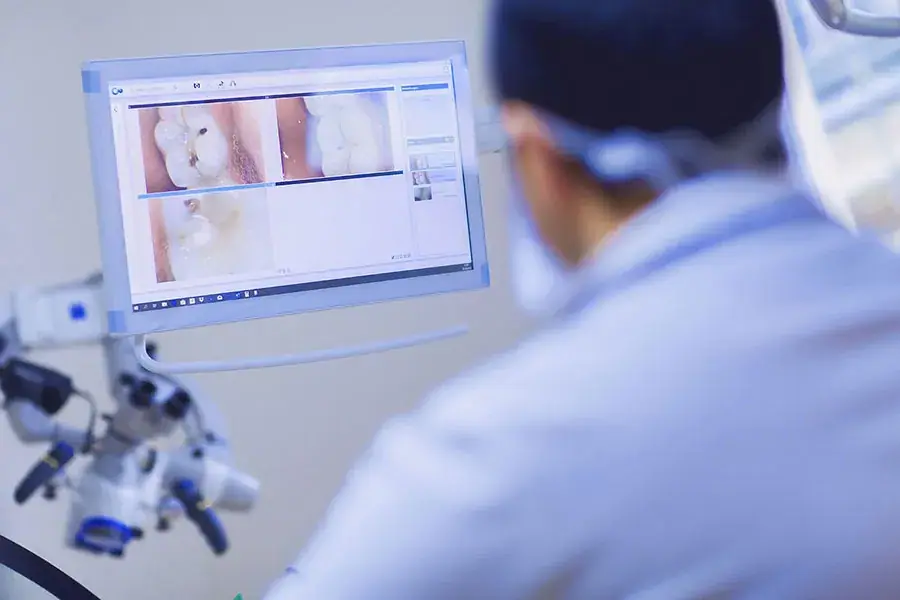
What is CAD/CAM in Dentistry?
CAD/CAM stands for Computer-Aided Design and Computer-Aided Manufacturing – computer-assisted planning and fabrication. In dentistry this means: the dentist scans the prepared tooth with an optical camera (intraoral scanner) instead of a conventional impression. The restoration (inlay, crown, veneer) is digitally designed on screen. A milling machine then automatically fabricates the piece from a ceramic block – in many cases on the same day.
Which Restorations Do We Fabricate with CAD/CAM?
CAD/CAM technology is suitable for a wide range of restorations – from small partial fillings to complete crowns.
Ceramic Inlays & Onlays
Ceramic inlays are tooth-coloured partial fillings for larger defects where a conventional composite filling reaches its limits. Onlays extend across the chewing surface as well. CAD/CAM enables an exact, more precisely fitting fabrication than conventional laboratory methods – often in one appointment.
- For larger defects after decay removal
- High-quality full ceramic – tooth-coloured & stable
- More conservative preparation than crowns
- In many cases completed in a single appointment
Partial Crowns & Full Crowns
When a tooth is too severely damaged for a filling but residual structure remains, a partial crown is used. Full crowns cap the entire tooth. CAD/CAM also enables precise digital planning and fabrication in full ceramic here.
- Precise fit through digital scan
- Full ceramic – aesthetic & biocompatible
- Also for restorations after root canal treatment
- Significantly reduced waiting time vs. laboratory fabrication
Veneers & Ceramic Shells
Ultra-thin ceramic shells (veneers) can also be digitally planned and milled. CAD/CAM veneers enable precise realisation of the planned smile design – with exact colour matching and natural translucency.
- Digital planning of the smile design
- Ultra-thin full ceramic shells
- Precise colour matching
- Complement to classic veneer fabrication
CAD/CAM Restoration Process
Digital Scan
Instead of a conventional impression with impression material, a small optical camera (intraoral scanner) scans the prepared tooth and surroundings in just a few minutes – comfortable and precise.
Digital Design (CAD)
The restoration is designed computer-assisted on screen – with exact adaptation to bite position, neighbouring teeth and individual anatomy. You can discuss the result digitally in advance.
Automatic Milling (CAM)
The milling machine fabricates the restoration fully automatically from a high-quality ceramic block – in approximately 15–30 minutes. The restoration is then finalised and individually characterised.
Try-in & Fitting
The finished restoration is tried in, checked for colour and fit, and permanently inserted after your approval – often everything in one appointment without a temporary.
Cost of CAD/CAM Restorations
Costs depend on the type and size of the restoration and individual treatment effort. Under Austrian dental chamber regulations we are not permitted to publish price information online.
Ceramic Inlay / Onlay
Partial filling from full ceramic – for larger defects. Price depends on size and effort. Often completed in one appointment.
Request cost planCrown / Partial Crown
Complete or partial crown restoration from full ceramic – digitally planned and fabricated. Price based on individual assessment.
Book consultationVeneer (CAD/CAM)
Aesthetic ceramic shells – digitally planned for optimal smile design. Price depends on number and effort.
Request appointmentCAD/CAM full ceramic restorations are private treatments. Certain insurance subsidy arrangements exist for dental restorations for statutory patients – we will clarify together with you what is possible. This also applies to SVS and KFA members, with whom we have a contract.
Who is the treatmentsuitable for?
When is CAD/CAM the right choice?
- Larger decay defects for which fillings are no longer sufficient
- Teeth after root canal treatment (crown for protection)
- Patients who want to avoid temporaries and multiple appointments
- Aesthetic restorations with maximum precision
- Patients with a strong gag reflex (no conventional impression needed)
- Technically demanding cases with complex geometry
When is laboratory fabrication preferable?
- Extensive restorations involving multiple teeth (bridges with more than 3 units)
- Cases requiring highly individual dental artistry and characterisation
- Certain implant-supported superstructures
- Based on individual assessment, classic laboratory fabrication is sometimes preferable
CAD/CAM and classic dental technology are not mutually exclusive – we choose the method that delivers the best result for each individual case.
Complementary Treatments
CAD/CAM is part of our digital treatment concept.
Veneers
Aesthetic ceramic shells – also digitally planned and CAD/CAM fabricated.
Learn moreRoot Canal Treatment
After root canal treatment: immediate CAD/CAM crown in one appointment.
Learn more3D X-Ray (CBCT)
Digital CBCT data as the basis for precise digital treatment planning.
Learn moreImplants
Digitally planned implant-supported superstructures from full ceramic – precise & aesthetic.
Learn moreFrequently askedquestions
Dental Restoration in One Appointment –
Digital & Precise
Book your consultation and find out whether CAD/CAM is an option for your restoration.